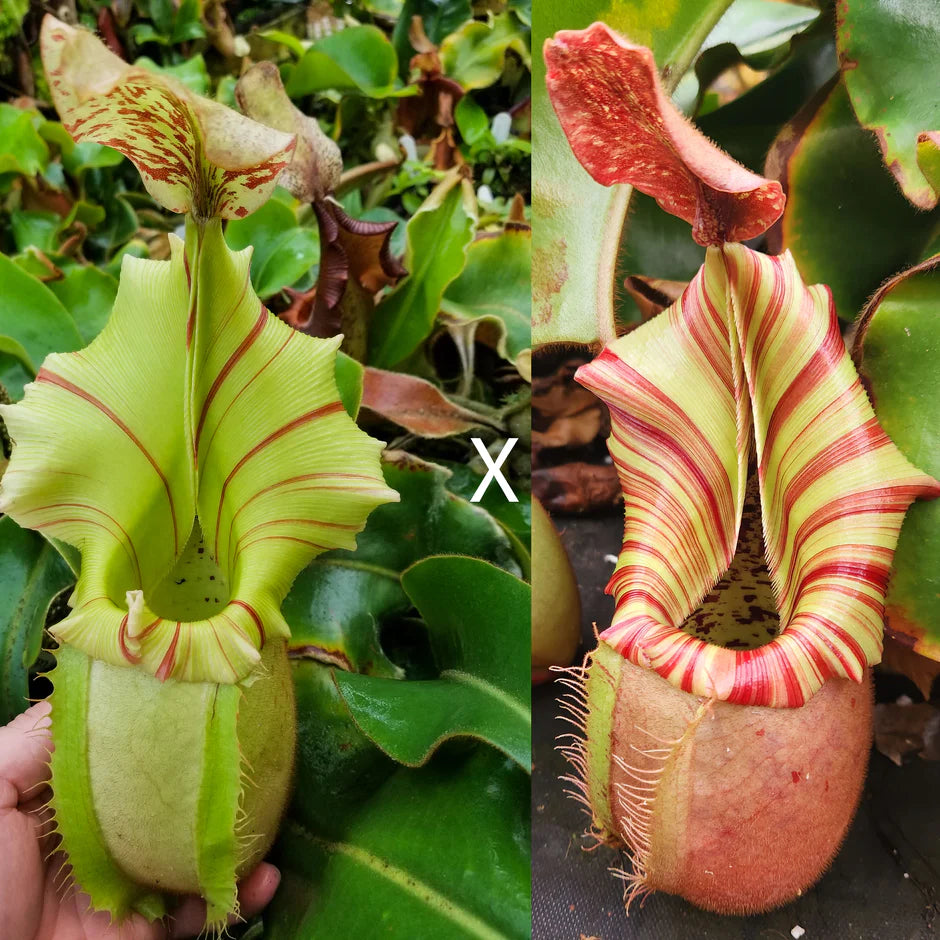
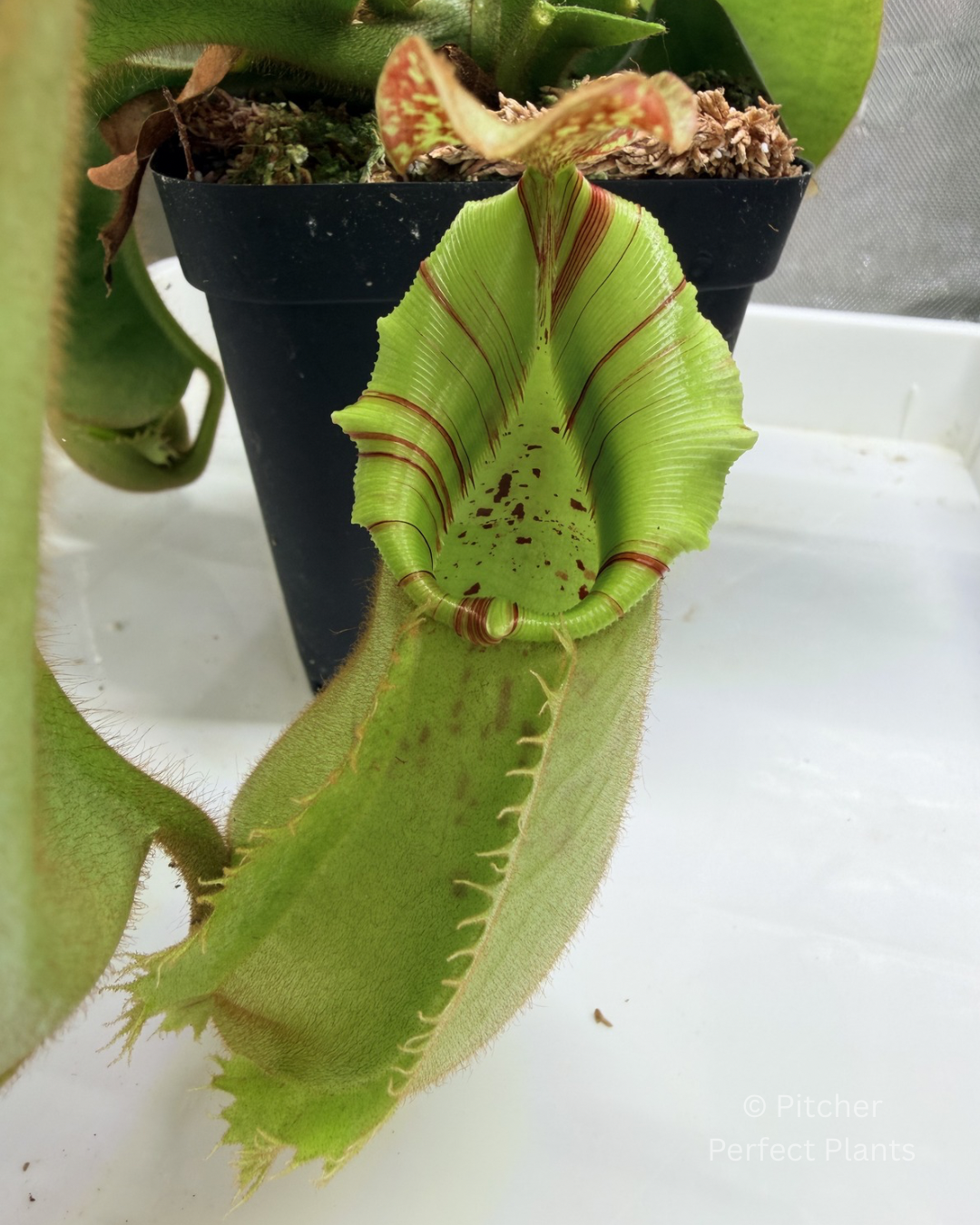
Nepenthes veitchii (Thai Bareo Giant x 'Candy Dreams')
Nepenthes veitchii (Thai Bareo Giant x 'Candy Dreams')
Couldn't load pickup availability
Share
Nepenthes veitchii (Thai Bareo Giant x 'Candy Dreams'), CAR-1051, Seed-grown.
We will only be selling a few of these due to low germination.
The main photo is of the parent plants (from Carnivero).
Current Growing Conditions
Current Growing Conditions
Temperatures: Between 65-85°F with 10°F temperature drops at night.
Lighting: 12-14 hours of bright, indirect light.
Humidity: Growing in 75%+ humidity but can be acclimated to lower humidity.
Size Guide
Size Guide
XS size: 1 to 2 inches wide.
Small size: 2 to 4 inches wide.
Medium size: 4 to 6 inches wide.
Large size: 6 to 9 inches wide.
XL size: 9+ inches wide.
Care Guide
Care Guide
Growing Media
Use an airy, well-draining mix such as:
The roots require excellent airflow, so avoid dense or compacted media.
Light
- Provide bright, indirect light for 10–14 hours daily.
- An east-facing window or a bright south or west window with sheer curtains works well.
- Under grow lights, keep plants approximately 8–18 inches (20–45 cm) below full-spectrum LEDs, depending on light intensity.
Temperature
Intermediate Nepenthes appreciate a noticeable day-to-night temperature change. A 10°F+ temperature drop at night is recommended.
- Day: 72–82°F (22–28°C)
- Night: 58–68°F (14–20°C) OR 10°F+ temperature drop at night.
Most intermediate species tolerate brief fluctuations outside this range.
Humidity
- Ideal humidity: 60–80% (80%+ is fine with good airflow).
- Most Intermediate Nepenthes can be adapted to lower humidity if acclimated gradually over the course of a few weeks using the Plastic Bag Method: Place plant in a resealable plastic bag and open 25% of the seal each week for four weeks. Remove the plant on the fifth week.
- Humidifiers, enclosed grow shelves, and grow tents work well in dry homes.
Watering
- Use only distilled, reverse osmosis (RO), rainwater, or well water with low TDS (no higher than 100 ppm, below 50 ppm is ideal).
- Never use regular tap water unless you know it has a very low mineral content. Tap water usually contains minerals that can harm the plant over time.
- Water thoroughly from the top until excess drains from the pot. This helps remove excess minerals and fertilizer.
- Keep the growing medium evenly moist.
- Avoid having the pot sitting in a tray of water.
- Allow the surface of the media to become slightly damp (like a wrung-out sponge) before watering again.
Feeding
Nepenthes naturally catch insects, but indoor plants appreciate occasional feeding.
- Feed one small insect or Osmocote pellet (Flower & Vegetable version) per pitcher every 2–4 weeks.
- Suitable foods include flies, crickets, mealworms, fish food pellets, dried insects, and Osmocote pellets (Flower & Vegetable version).
- Do not overfill pitchers or feed every pitcher at once.
If your plant catches insects naturally, supplemental feeding is usually unnecessary.
Fertilizer
Nepenthes can grow without fertilizer, but light feeding can encourage faster growth.
- Water with Maxsea 16:16:16 fertilizer at ¼ strength every two to four weeks. We normally only fertilize once a month to prevent over-fertilization. This can also be added to pitchers instead of feeding them solids.
- Osmocote pellets (Flower & Vegetable version) can be pushed into the growing medium. Maximum of one per square inch every couple months. Do not use Osmocote pellets and a liquid fertilizer at the same time as over-fertilization can kill your plants.
- Always flush the pot in-between fertilizing with pure water to prevent mineral buildup. Too much fertilizer can kill your Nepenthes.
Potting and Repotting
- Choose a pot with excellent drainage.
- Avoid oversized pots, which stay wet longer and may increase the risk of root rot.
- Spring is the ideal time to repot if a repot is needed.
- Only increase pot size by 2 inches when repotting to avoid issues like root rot.
- Nepenthes have black roots, this is normal. Beginners commonly mistake these black roots as root rot.
Pitcher Development
Healthy plants produce pitchers when they receive:
- Bright light
- Adequate humidity
- Consistent watering
- Stable temperatures
It is normal for a plant to pause pitcher production for a few weeks or months after shipping, repotting, or major environmental changes.
Common Problems
No pitchers
- Insufficient light
- Low humidity
- Recent environmental changes
- Plant acclimating after shipping or repotting
Dried pitchers
- Normal aging
- Low humidity
- Growing media dried out
- Over-feeding can cause a pitcher to brown more quickly
- It is normal for the oldest leaves/pitchers to brown as new growth arrives. We recommend waiting until the leaf is fully brown/dry before removing.
Mushy roots (root rot)
- Poor drainage
- Overly compact media
- Waterlogged conditions
- Pot size too big
- Nepenthes have black roots, this is normal. Beginners commonly mistake these black roots as root rot.
Slow growth
- Low light
- Cool daytime temperatures
- Lack of pitcher feeding and/or fertilization
- Inconsistent watering