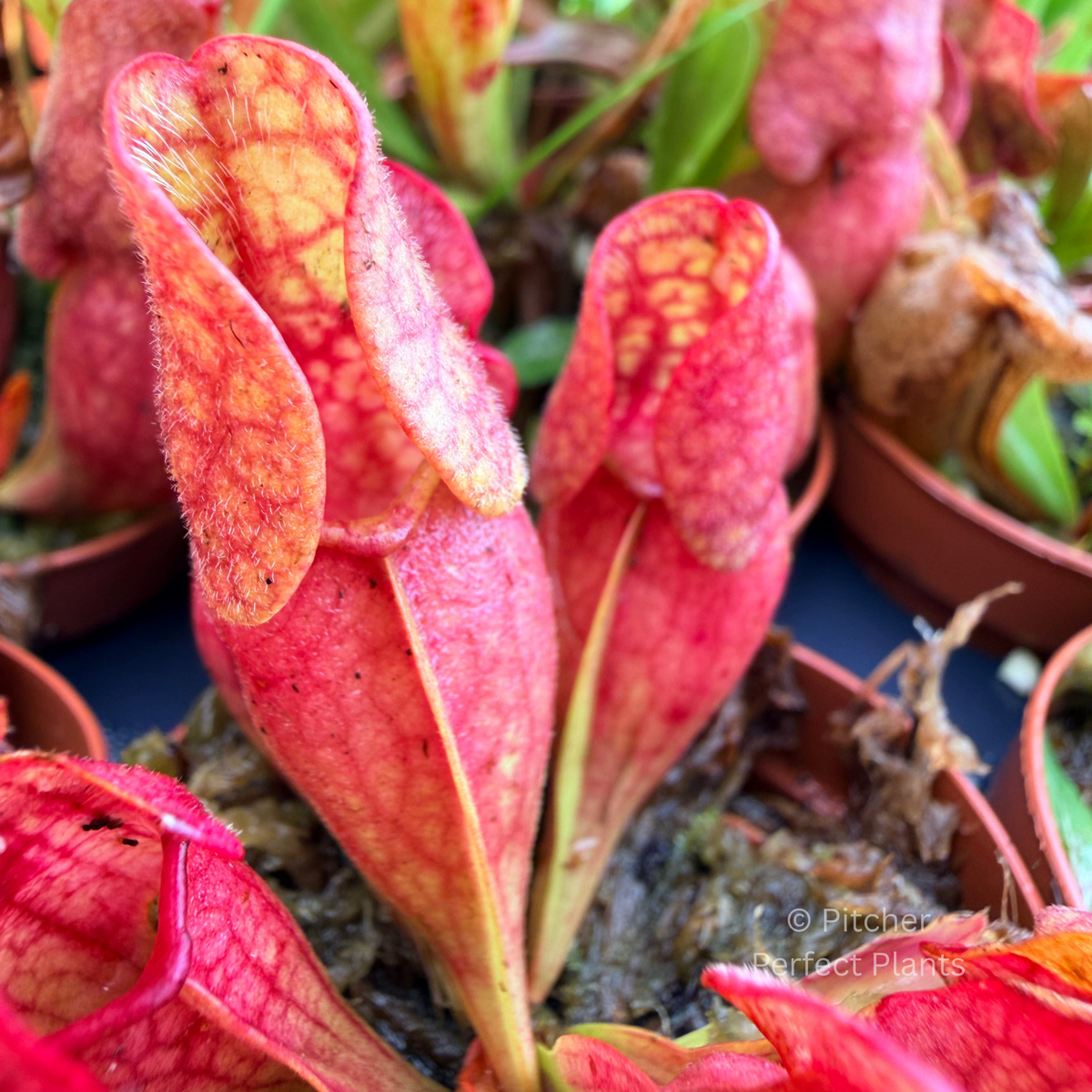
Sarracenia purpurea venosa
Sarracenia purpurea venosa
Couldn't load pickup availability
Share
Sarracenia purpurea venosa is one of the most recognizable North American pitcher plants. This hardy species produces beautifully curved, ground-hugging pitchers in rich shades of burgundy and deep purple, accented with striking veining and textured lids. Unlike many upright pitcher plants, Sarracenia purpurea venosa forms a low rosette of open pitchers that collect rainwater and naturally trap insects. Their dramatic coloration and unusual form make them a standout addition to carnivorous plant displays, terrariums, and outdoor bog gardens.
Sarracenia, commonly called North American pitcher plants and trumpet pitcher plants, are striking carnivorous plants known for their tube-shaped leaves that act as passive traps. Native to the southeastern United States and parts of Canada, their pitchers lure insects with nectar, then trap and digest them in a pool of enzymes and rainwater. Many species develop beautiful colors and veining, making them popular among collectors.
Growing Guide
Growing Guide
Soil: Use a nutrient-poor mix such as sphagnum peat moss (without added fertilizer) with perlite. Long fiber sphagnum moss and perlite also works great. Avoid fertilizers and regular potting soil, as they can kill the plant.
Light: Sarracenia like full sun. Ideally 6–8+ hours of direct sunlight daily. Strong light is essential for healthy growth and vibrant coloration.
Watering: Use distilled, rainwater, reverse osmosis water, or well water with low TDS (no higher than 100 ppm, below 50 ppm is ideal). Keep the soil consistently wet by keeping the pot in a shallow tray of water, especially during the growing season.
Feeding: Outdoor plants will catch their own prey. Indoors, you generally don’t need to feed them often, but occasional small insects can help. Never use fertilizer in the soil.
Dormancy: Sarracenia require a winter dormancy period of about 3–4 months with cooler temperatures (roughly 35–50°F / 2–10°C). Pitchers may die back, and growth will slow which is normal and necessary for long-term health.
Humidity & Temperature: They tolerate a wide range of humidity but prefer warm conditions (70–90°F / 21–32°C) during active growth.
Potting Tips: Use plastic or glazed pots rather than terracotta, which can leach minerals into the soil.